

How To Draw Something In Photoshop
Learn how to easily turn whatever photo into a black and white pencil sketch with Photoshop, and so learn iii peachy ways to colorize the sketch!
Version note: This tutorial is for Photoshop CC 2019 and before. An updated version is available for Photoshop 2020 and 2021.
In this tutorial, we'll larn how to hands create a classic Photoshop effect, turning a photo into a pencil sketch! In fact, we'll actually learn how to create four variations of the sketch consequence, starting with a simple black and white version. We'll and then accept our black and white sketch and learn a few unlike ways to colorize it, first using the photo's original colors, so with a unmarried colour, and then with a gradient!
We'll also acquire how to proceed our pencil sketch flexible and editable, letting u.s.a. go dorsum and fine-tune things as needed, by taking reward of Photoshop'due south Smart Filters, fill up and adjustment layers, and layer alloy modes.
This version of the tutorial is uniform with Photoshop CC 2019 and earlier, including Photoshop CS6. But Photoshop 2020 or 2021 users volition want to check out my updated version which includes contempo changes to Photoshop'south gradients.
Hither's the image I'll be using (fashionable beauty portrait photo from Shutterstock):
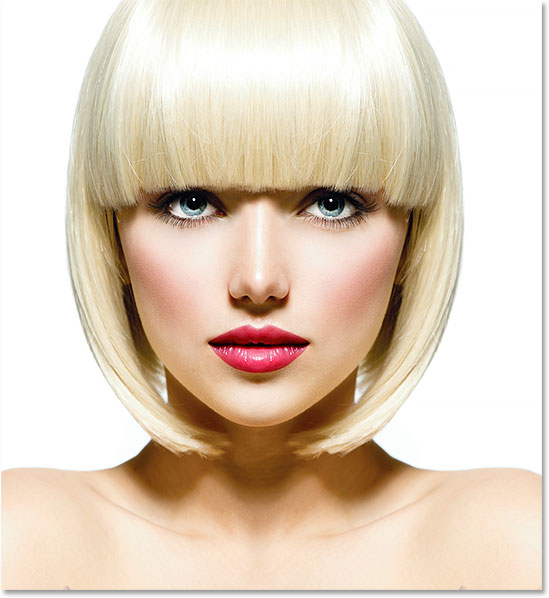
The original prototype.
Here's how it will look as the initial black and white sketch:
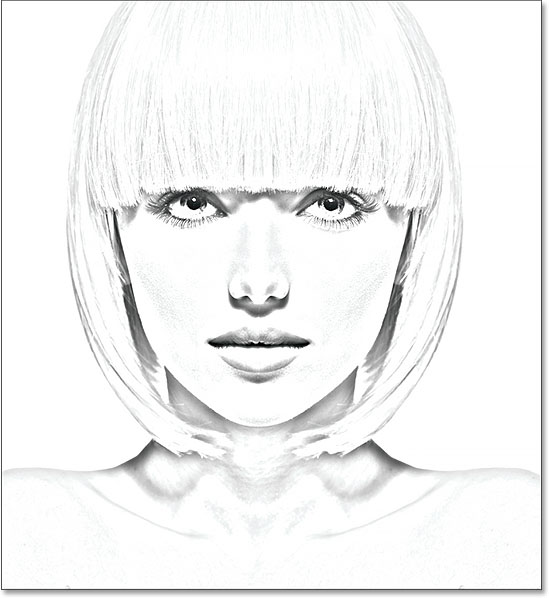
The black and white version of the sketch.
Hither's the same sketch colorized with the photo's original colors:
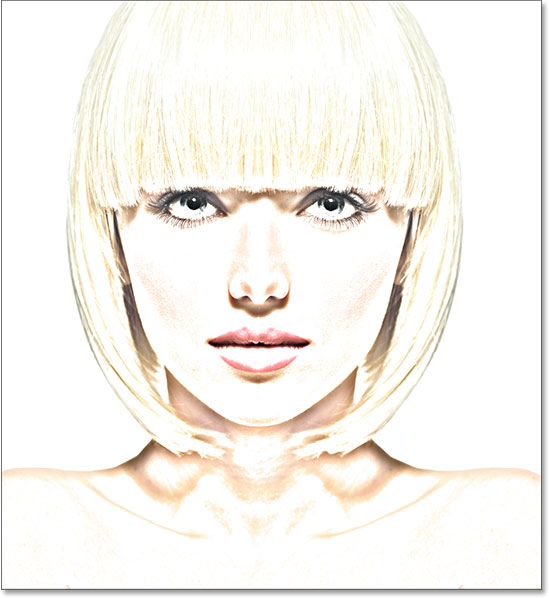
The first colorized version of the sketch.
Here's the same sketch once again, this time colorized with a single color (yous can cull whatever color you like):
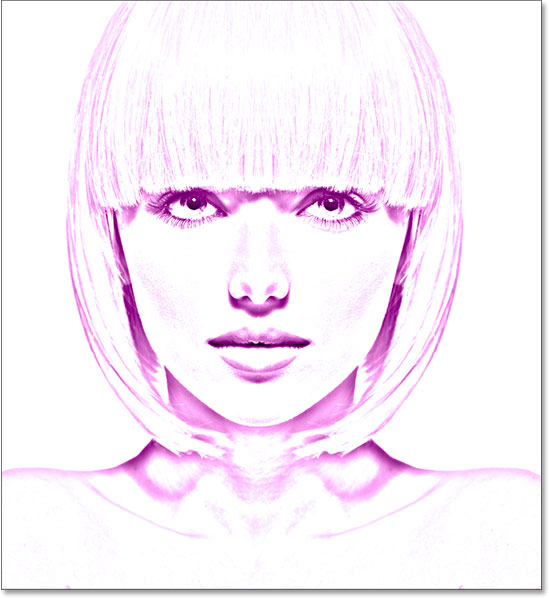
The second colorized version of the sketch.
And finally, here'southward how the sketch volition look later colorizing it with a gradient. At the terminate of the tutorial, we'll see how to easily switch between all 4 versions and then you can cull the one you lot like best:
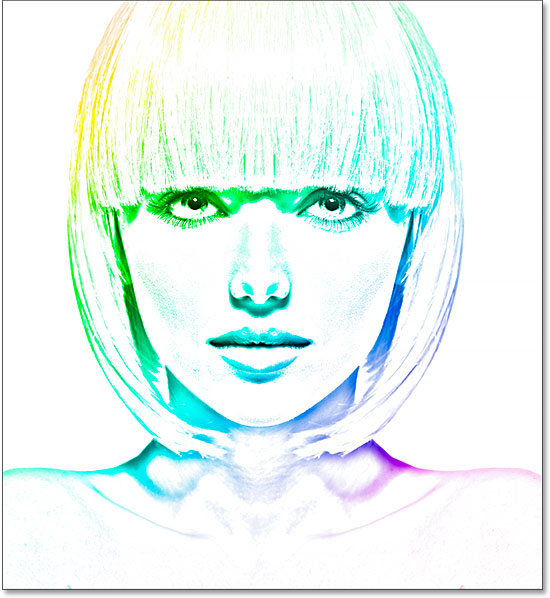
The third colorized version of the sketch.
Let's get started!
How To Turn A Photo Into A Pencil Sketch With Photoshop
Step 1: Indistinguishable The Background Layer
With your paradigm newly opened in Photoshop, if you expect in your Layers panel, yous'll come across the image sitting on the Background layer, currently the only layer in the document:
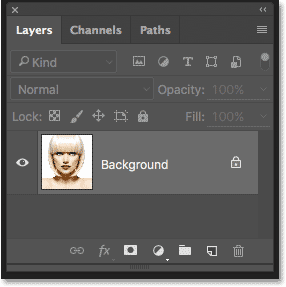
The Layers panel showing the photo on the Background layer.
Nosotros're going to need this original image again later when we go to colorize the sketch, which means nosotros'll need to make sure nosotros don't make any changes to it. To go along it rubber, the first thing nosotros'll practice is brand a copy of the image by duplicating the Background layer.
To exercise that, click on the Groundwork layer and elevate it downwardly onto the New Layer icon at the bottom of the Layers console (second icon from the right):
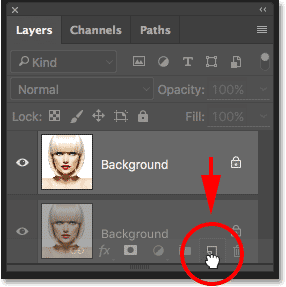
Dragging the Background layer onto the New Layer icon.
Release your mouse button when your hand cursor is direct over the New Layer icon. Photoshop makes a copy of the Background layer, names it "Background copy" and places it above the original:
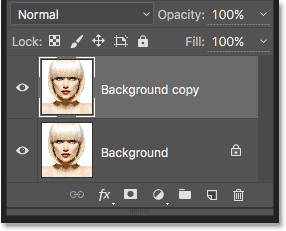
The Layers panel showing the new "Background re-create" layer.
Footstep 2: Desaturate The Layer
Adjacent, we need to remove all of the color from our "Background re-create" layer, and we can practise that quickly using Photoshop's Desaturate command. Get up to the Paradigm menu in the Carte du jour Bar along the top of the screen, choose Adjustments, and and then choose Desaturate. You tin can also use the keyboard shortcut Shift+Ctrl+U (Win) / Shift+Command+U (Mac):
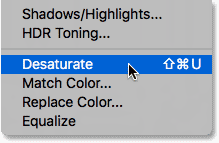
Going to Prototype > Adjustments > Desaturate.
Either manner desaturates the image, leaving us with a black and white version of our photograph:
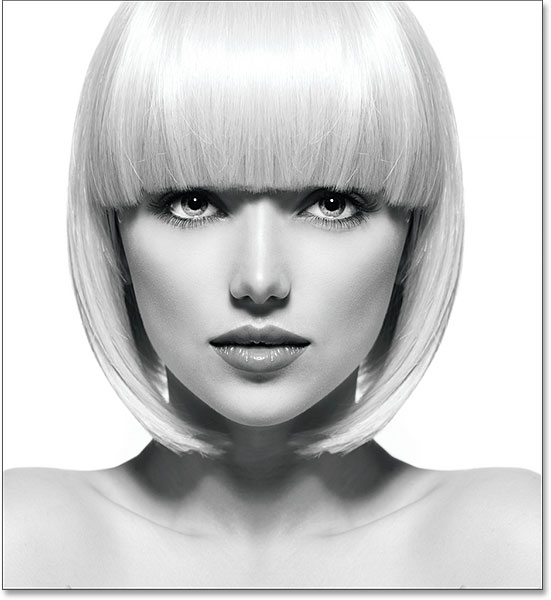
The image afterward desaturating the color.
Pace 3: Duplicate The Desaturated Layer
Adjacent, we need to make a copy of our desaturated layer. Click on the Background re-create layer in the Layers console and, merely as we did with the original Groundwork layer, drag information technology down onto the New Layer icon:
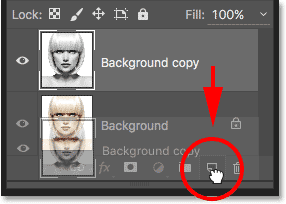
Dragging the "Background copy" layer onto the New Layer icon.
When you release your mouse push button, Photoshop makes a copy of the layer, names it "Groundwork copy ii" and places information technology above the other layers:
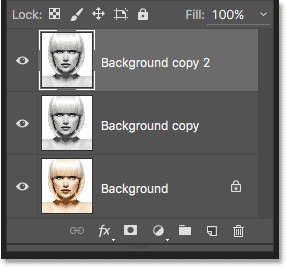
The new "Background copy 2" layer appears at the top of the layer stack.
Stride four: Invert The Layer
Nosotros need to invert the brightness levels in this layer, making calorie-free areas nighttime and nighttime areas calorie-free, and we can practice that using Photoshop's Invert command. Become up to the Image menu at the elevation of the screen, choose Adjustments, and then choose Capsize (keyboard shortcut: Ctrl+I (Win) / Control+I (Mac)):
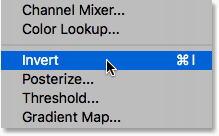
Going to Paradigm > Adjustments > Invert.
This inverts the image, creating a moving picture negative effect:
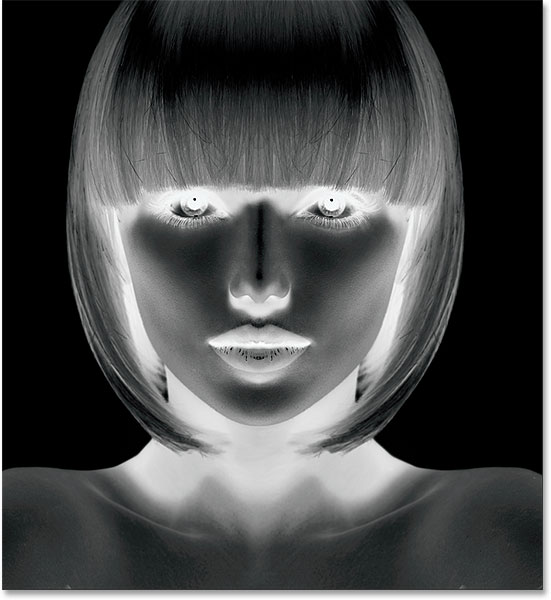
The image after inverting the brightness.
Step 5: Change The Blend Style To Color Contrivance
Side by side, we need to alter the blend way of the layer. You'll find the Blend Mode option in the upper left of the Layers panel. By default, the blend fashion is fix to Normal. Click on the give-and-take "Normal" to bring up a menu of other blend modes and choose Color Dodge from the list:
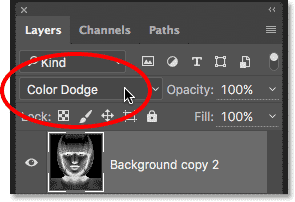
Changing the blend manner of the layer from Normal to Color Dodge.
This will turn the certificate completely white, or at least by and large white (yous may see a few scattered areas of blackness depending on your image):
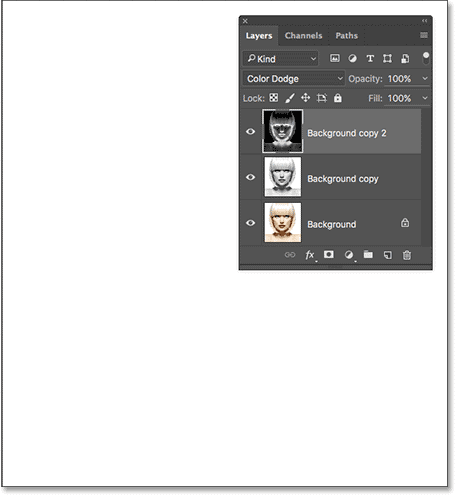
Irresolute the alloy fashion to Colour Dodge turns the document temporarily white.
Footstep 6: Convert The Layer Into A Smart Object
In a moment, we're going to create the main function of our sketch outcome by blurring the layer using Photoshop's Gaussian Blur filter. But rather than applying it as a normal filter, let's utilize Gaussian Blur equally a Smart Filter.
What'due south a Smart Filter, and how is it different from a normal filter? Well, Smart Filters are but like normal filters in Photoshop, only smarter! What makes them "smarter" is that while normal filters produce static results (that is, they make permanent changes to the pixels on a layer), Smart Filters are non-subversive and remain fully editable. They let us to easily get back at any time and make changes to the filter's settings without any loss of image quality. By applying Gaussian Blur as a Smart Filter, we're giving ourselves the option to go dorsum and fine-tune our sketch upshot subsequently rather than locking ourselves in with our initial filter settings.
And then how do we use Gaussian Blur every bit a Smart Filter? For that, nosotros get-go need to convert the layer to a Smart Object. Why do nosotros need to convert it into a Smart Object? It's considering, when a filter is applied to a normal layer, information technology remains a normal, static filter. But when the verbal same filter is applied to a Smart Object, it automatically becomes a Smart Filter!
To convert the layer into a Smart Object, click on the pocket-sized menu icon in the upper right corner of the Layers console:
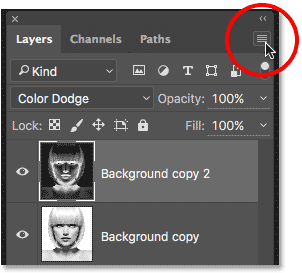
Clicking the Layers console menu icon.
Then cull Convert to Smart Object from the carte that appears:
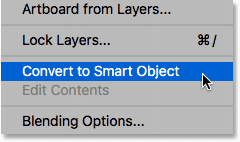
Choosing the "Convert to Smart Object" command.
It may not seem like anything has happened, merely if nosotros look over again in the Layers panel, we now see a small Smart Object icon in the lower correct corner of the layer'south preview thumbnail. This tells us that the layer is now a Smart Object:
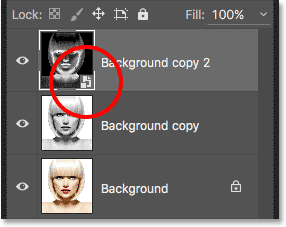
The Smart Object icon in the layer's preview thumbnail.
Stride 7: Utilise The Gaussian Blur Filter
Now that we've converted the layer into a Smart Object, let's apply the Gaussian Blur filter. Go up to the Filter carte in the Menu Bar forth the top of the screen, choose Mistiness, so choose Gaussian Blur:
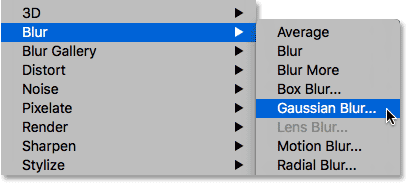
Going to Filter > Blur > Gaussian Blur.
This opens the Gaussian Blur dialog box. To create our main sketch outcome, all we need to do is apply some blurring to the layer (the Smart Object). We control the amount of blurring using the Radius slider forth the lesser of the dialog box. The further nosotros drag the slider towards the right, the more we increase the radius value and the stronger the blurring will appear.
The consequence you attain volition depend on how much blurring you've applied. Lower radius values will create a sketch with fine, thin lines, while larger values volition give you a more photograph-realistic outcome. For example, if I choose a fairly low radius value of around 10 pixels:
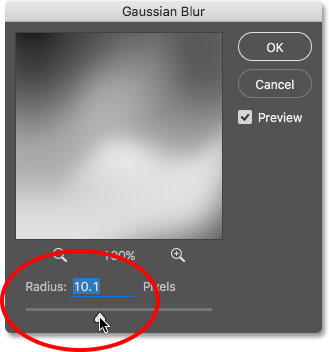
Starting with a lower radius value.
I cease up with this effect here with very fine lines:
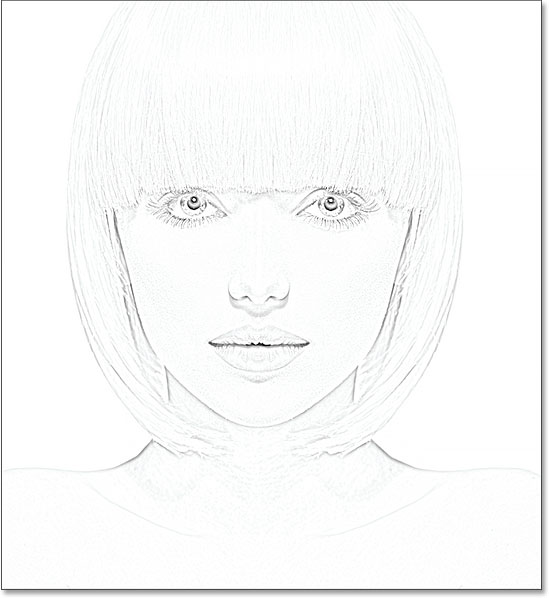
The sketch effect using a lower radius value.
If I increase the radius value to something much higher, mayhap somewhere around 45 pixels:
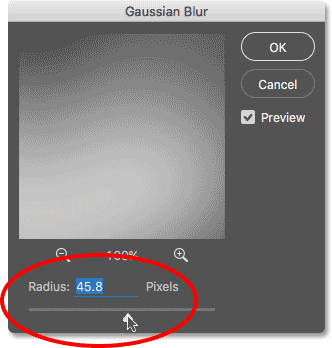
Increasing the radius value for a stronger blur effect.
I end up with an event that looks more than like the original photograph. The exact radius value you choose will depend both on your image and the type of effect yous're going for, so the all-time thing to practise is proceed an eye on your image as you drag the Radius slider and gauge the results. In my example, even though I similar both versions, I think I like this second, more photo-realistic version a flake better, so I'll go with this one. Click OK when yous're washed to close out of the Gaussian Blur dialog box:
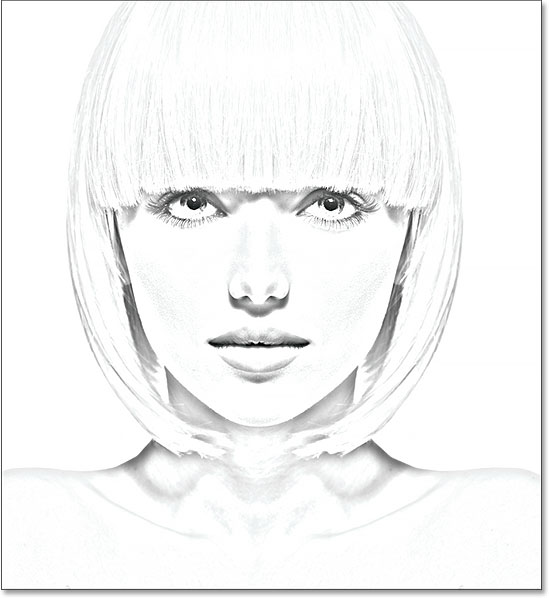
The sketch effect with a larger radius value.
We accept our main sketch result, and nosotros created information technology using a Gaussian Blur Smart Filter. As I mentioned earlier, Smart Filters remain fully editable, allowing us to hands become back and alter the filter's settings later if needed. How practise nosotros do that? Well, if we look again in the Layers console, we now see the Gaussian Blur filter listed as a Smart Filter beneath the Smart Object we applied it to. If, at whatever bespeak, you lot first thinking that your sketch could employ a bit more than fine-tuning, just double-click directly on the words "Gaussian Blur" to re-open the Gaussian Blur dialog box and elevate the Radius slider as needed:
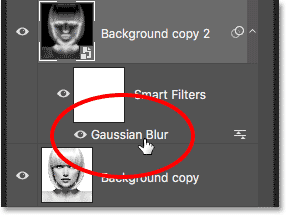
Double-clicking the Gaussian Blur Smart Filter will re-open its dialog box.
Step 8: Add A Levels Adjustment Layer
We've created our main sketch effect, but depending on how much blurring you applied, you may exist finding that your sketch is looking besides light. If that's the case, we can easily darken it using a Levels aligning layer. To add together a Levels adjustment layer, click on the New Fill or Adjustment Layer icon at the bottom of the Layers panel:
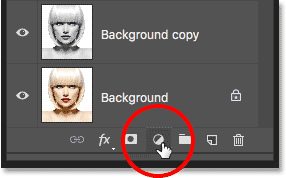
Clicking the New Fill or Adjustment Layer icon.
Cull Levels from the list that appears:
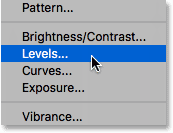
Choosing a Levels aligning layer.
Photoshop adds a Levels adjustment layer, names information technology "Levels ane", and places it in a higher place the other layers in the Layers panel:
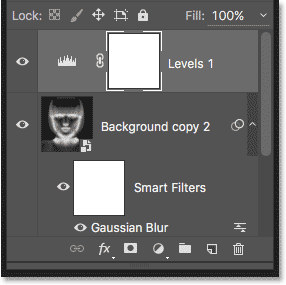
The Layers panel showing the new Levels adjustment layer.
Footstep nine: Change The Layer Blend Mode To Multiply
The options and controls for the Levels adjustment layer appear in Photoshop's Properties console, simply in that location's nothing here that we need to do with them. Instead, to darken the sketch, all we need to do is alter the blend manner for the Levels adjustment layer from Normal to Multiply:
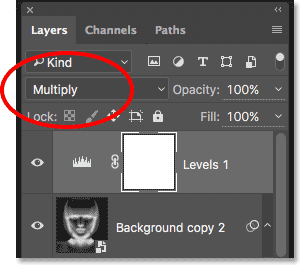
Changing the blend way of the adjustment layer to Multiply.
The Multiply blend mode is one of a group of blend modes in Photoshop that darken the paradigm, and right away, nosotros see that my sketch at present appears much darker:
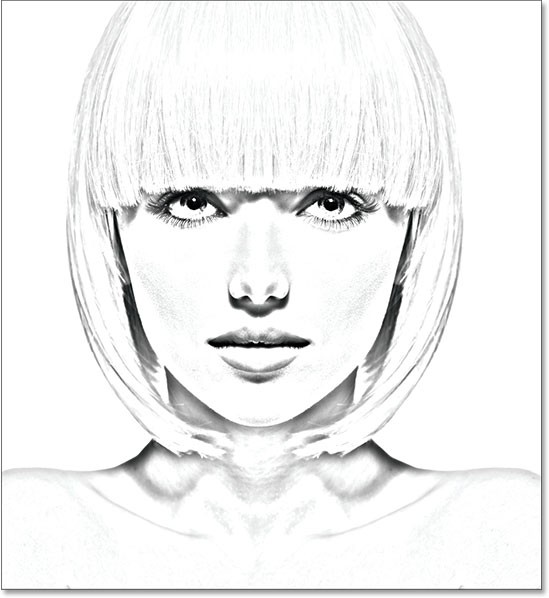
The effect after changing the Levels blend style to Multiply.
If you lot observe, as I do, that your sketch now appears as well dark, y'all can fine-tune the amount of darkening past adjusting the opacity of the Levels aligning layer. You'll find the Opacity option directly beyond from the blend mode option at the top of the Layers panel.
The more you lower the opacity value below its default 100%, the more than the layers below the Levels adjustment layer will prove through, brightening the sketch dorsum up. I'll lower mine down to around 40%, merely keep an eye on your prototype as you suit the opacity to find the value that works best:
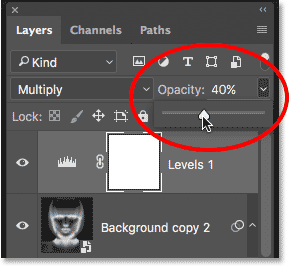
Lowering the opacity of the Levels adjustment layer.
After lowering the opacity, the overall brightness is at present looking meliorate:
Lowering the opacity brought back some of the brightness.
Step ten: Indistinguishable The Background Layer Again
At this point, we have our primary sketch upshot, merely currently it'southward in blackness and white. Permit's expect at a few dissimilar ways to colorize information technology. Nosotros'll start by using the photograph's ain original colors. For that, we need to make another copy of the Background layer, so click on the Groundwork layer (the original Background layer that'south sitting below the other layers) and, just as we've done a couple of times already, drag information technology down onto the New Layer icon at the bottom of the Layers panel:
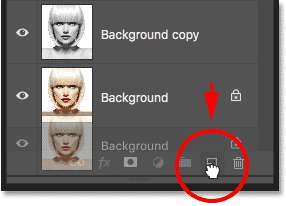
Making another copy of the Groundwork layer.
Photoshop makes a re-create of the layer, names it "Background copy 3" and places it directly above the original Groundwork layer:
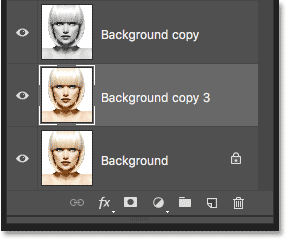
The "Groundwork copy 3" layer appears above the original Background layer.
Step 11: Rename The New Layer
We've created so many copies of our Groundwork layer at this point that our Layers console is condign cluttered with them, and they all accept names ("Background re-create", "Background copy 2", "Groundwork copy iii") that don't tell u.s.a. anything about what the layer is being used for. Permit'south break the cycle and rename the layer we just created.
We're going to be using the "Background copy iii" layer to colorize our sketch, and then permit's give it more descriptive name. To rename a layer, double-click directly on its name to highlight it:
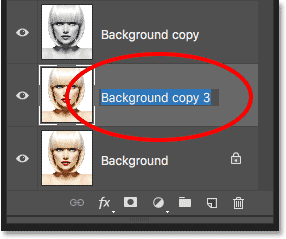
Highlighting the current name by double-clicking on it.
With the name highlighted, type in the new proper name. Allow's name it "Color". Press Enter (Win) / Return (Mac) on your keyboard when you lot're done to accept the proper noun change:
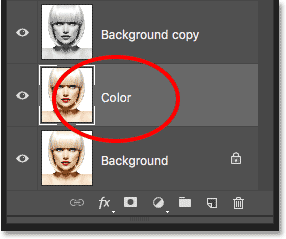
Irresolute the layer'due south name to "Colour".
Step 12: Move The "Color" Layer To The Top Of The Layer Stack
To use this layer to colorize the sketch, we need to move it up to the top of the layer stack; in other words, motion information technology to a higher place all the other layers. One way to exercise that would exist to click on it and only drag it upwards to a higher place the other layers, simply at that place'south a faster way. To spring a layer directly to the meridian of the layer stack, get-go brand sure it'southward selected in the Layers panel. Then, printing and hold Shift+Ctrl (Win) / Shift+Control (Mac) on your keyboard and press your right subclass key ( ] ). This will instantly jump the selected layer straight to the top:
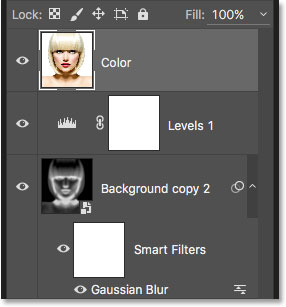
The "Colour" layer now sits at the peak of the layer stack.
Footstep xiii: Change The Alloy Mode To "Color"
With the "Color" layer at present the height-well-nigh layer in the document, your original image will re-appear, blocking the other layers beneath it from view, which is obviously not what we desire. We want to alloy the color from the original paradigm in with our sketch. To do that, simply change the blend way of the "Colour" layer from Normal to Color:
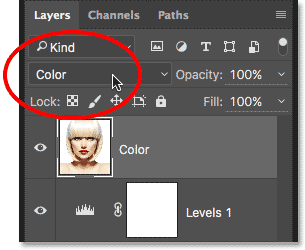
Changing the blend mode of the layer to Color.
The Color blend mode tells Photoshop to blend only the colour from this layer and ignore everything else, and but like that, the sketch is now colorized:
The sketch colorized with the photograph's original colors.
If the colour appears too strong, you lot tin reduce information technology by lowering the opacity of the "Color" layer. I'll lower mine down to l%:
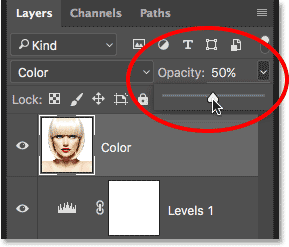
Lowering the opacity of the "Colour" layer.
And now, the color appears more than subtle:
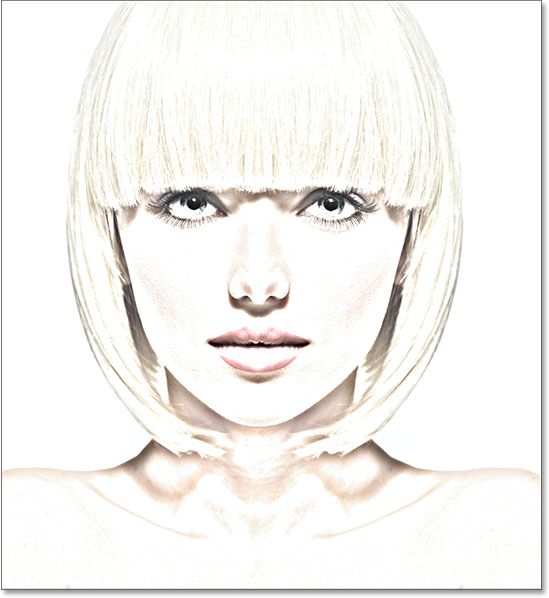
The effect after lowering the opacity of the "Color" layer.
Acquire More: The Five Layer Blend Modes You Need To Know
Pace 14: Turn Off The "Color" Layer
If yous like the manner your sketch effect looks using the photograph's original colors, you can cease here. Otherwise, allow'southward look at a second way to colorize it, this time using a single color. Before we do, allow's plow off the "Color" layer by clicking its visibility icon (the "eyeball" icon) in the Layers panel. This will bring back the black and white version of the sketch:
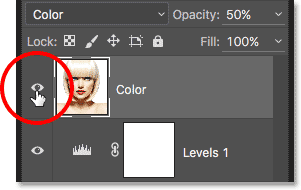
Turning off the "Color" layer by clicking its visibility icon.
Step 15: Add A Solid Color Fill Layer
To colorize the sketch with a single colour, we'll utilize i of Photoshop'southward Solid Color make full layers. Click once over again on the New Fill or Aligning Layer icon at the bottom of the Layers panel:
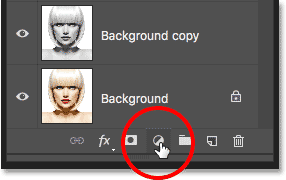
Clicking the New Make full or Adjustment Layer icon.
Then choose Solid Colour from the summit of the list that appears:
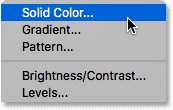
Choosing a Solid Colour make full layer.
As shortly as yous select the Solid Color fill layer, Photoshop will pop open the Color Picker, request you to choose your color. Don't worry nearly choosing the wrong colour here because, as we'll run across in a moment, nosotros can easily come up back and pick a different one. I'll cull a shade of blue to run into what that looks like:
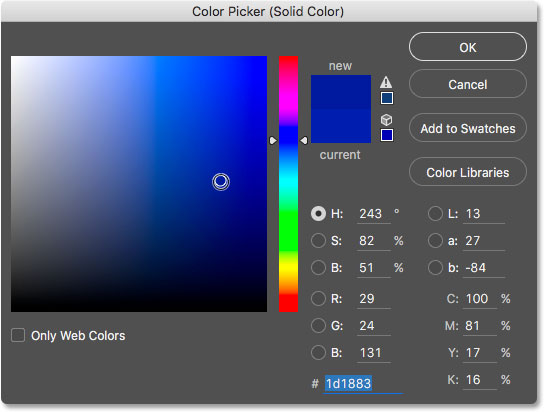
Choosing blue from the Color Picker.
Footstep 16: Change The Blend Mode To Color
One time you've chosen a color, click OK to close out of the Color Picker. Your document will temporarily be filled with that colour, and if you wait in the Layers panel, you'll see the new fill up layer, named "Color Fill 1", sitting at the meridian.
To blend the color in with the sketch, simply change the fill layer's blend mode from Normal to Color:
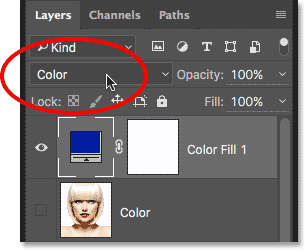
Changing the fill layer's blend way to Colour.
And now, the sketch appears colorized, in my case with blueish:
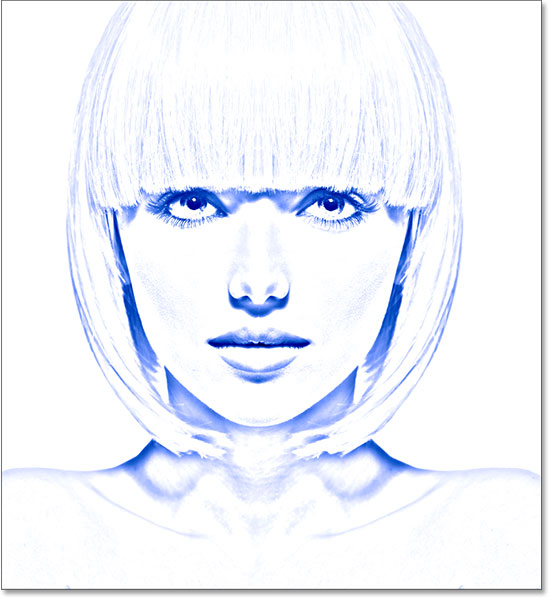
The sketch colorized with bluish.
If you want to try a different colour, double-click on the fill layer's colour swatch in the Layers panel:
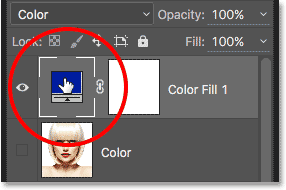
Double-clicking the make full layer's color swatch.
This re-opens the Color Picker, allowing y'all to choose something different. I'll effort a pinkish-purple this time:
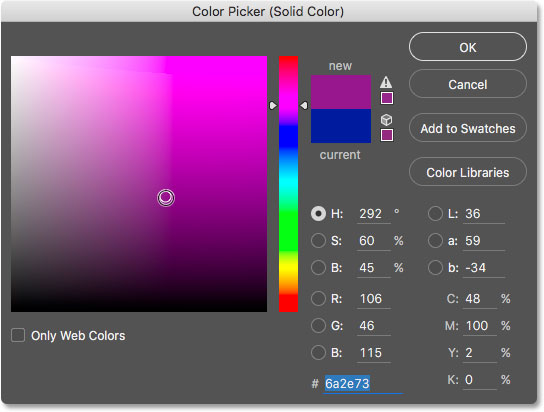
Choosing a different color from the Color Picker.
I'll click OK to close out of the Colour Picker, and now my sketch appears with my new color. You tin go back and try as many different colors as y'all similar until you find the ane that works all-time:
The sketch colorized with purple.
To reduce the intensity of the colour, simply lower the fill layer'due south opacity, keeping an eye on the results as you lot drag the slider:
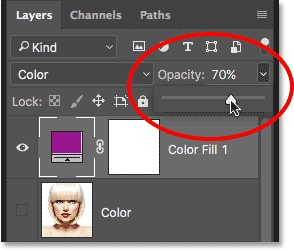
Lowering the opacity of the fill layer.
Stride 17: Turn Off The Fill Layer
Let'south wait at one more way to colorize the sketch, this time using a slope. First, turn off the fill layer past clicking on its visibility icon in the Layers console. This volition in one case once more return you lot to the black and white version of the sketch:
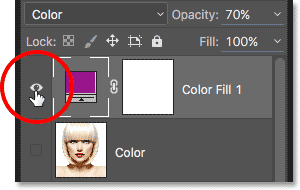
Clicking the fill up layer's visibility icon.
Pace 18: Add together A Gradient Fill up Layer
To colorize the sketch with a slope, we'll apply a Slope fill layer. Click one time over again on the New Make full or Adjustment Layer icon at the bottom of the Layers panel:
Clicking the New Fill or Adjustment Layer icon.
This time, choose Gradient from the list:
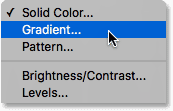
Choosing a Gradient fill up layer.
This opens the Gradient Fill dialog box. I covered everything you lot need to know nigh cartoon and editing gradients in Photoshop in our How To Draw Gradients With The Gradient Tool and How To Use The Gradient Editor tutorials so I won't go into detail here. Instead, allow'southward look at how to quickly select one of Photoshop'south preset gradients and how to employ it to our sketch.
To cull a gradient, click on the modest arrow to the right of the gradient colour swatch at the meridian of the dialog box. Don't click on the colour swatch itself or y'all'll open the Gradient Editor which is beyond the scope of this tutorial. Brand sure you click on the arrow to the right of the colour swatch:
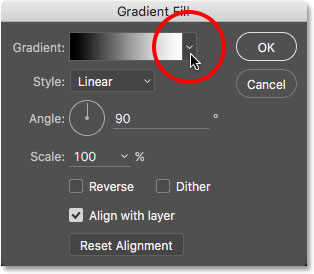
Clicking the pointer to the right of the gradient color swatch.
This opens the Gradient Picker, showing us thumbnails of preset gradients we can choose from. To select a gradient, double-click on its thumbnail. This will both select the gradient and close the Gradient picker. For this tutorial, I'll choose the Spectrum gradient (first thumbnail on the left, bottom row):
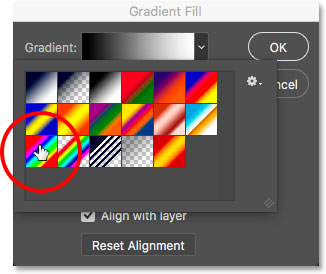
Selecting the Spectrum slope.
Dorsum in the Slope Make full dialog box, I'll modify the Angle of the gradient from its default 90° to 135°, which will cause it to run diagonally across the image, creating a bit more interest:
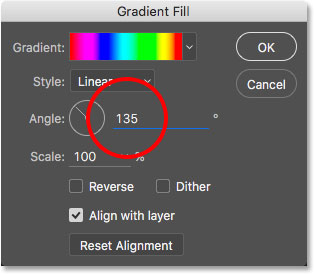
Changing the bending of the slope.
Click OK to close out of the dialog box when you're washed. Your certificate will temporarily exist filled with the gradient:
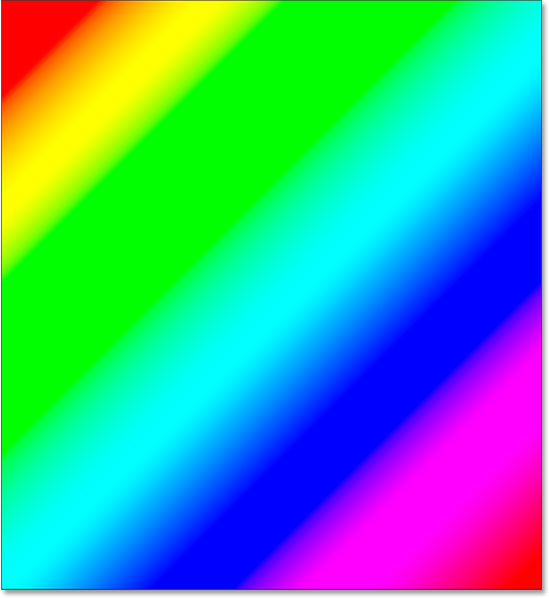
The gradient temporarily blocks the sketch from view.
Step xix: Change The Blend Style To Colour
If we look in the Layers console, we come across the Gradient fill layer ("Gradient Make full ane") sitting at the top. Only as we've done a couple of times already, to alloy the slope in with the sketch, simply alter the blend fashion of the Gradient Make full layer from Normal to Color:
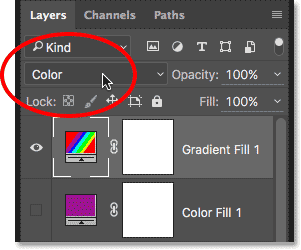
Changing the blend fashion of the Gradient Fill layer to Color.
Then, adjust the intensity of the colors if needed by lowering the layer's opacity:
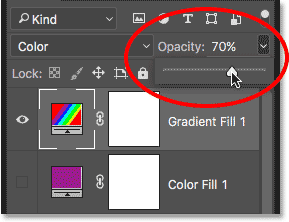
Lowering the opacity of the Slope Fill layer.
Hither'south what my sketch looks like colorized with the Spectrum slope:
The final colorized sketch outcome.
Choosing One Of The Previous Color Effects
Now that we've colorized the sketch with a gradient, what if you like one of the previous colorized versions better (the one using the photo's original colors or the one using the unmarried color)? Or, what if yous don't like any of the colorized versions and want to go back to the black and white version? How do yous switch dorsum?
It's easy. First, to hibernate the gradient, click on the Gradient Make full layer's visibility icon in the Layers console. With all three colorizing layers (the "Color" layer, the Solid Colour fill up layer and the Gradient Fill up layer) at present turned off, you'll be back to your black and white version:
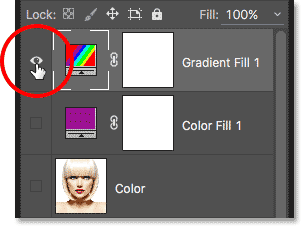
Clicking the Slope Make full layer's visibility icon.
Then, to bring dorsum the single color version, click on the Solid Colour fill layer'due south visibility icon (the empty square where the eyeball used to be) to turn it back on. Or, to bring back the photo's original colors, click the "Color" layer's visibility icon. I'll turn my "Color" layer dorsum on:
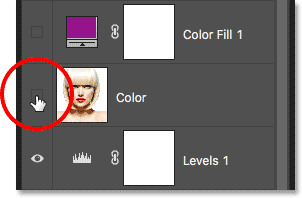
Clicking the "Color" layer's visibility icon.
And at present I'm dorsum to my sketch beingness colorized with the photo's original colors:
The original colors return.
And there we have it! That's how to easily plow a photo into a black and white pencil sketch, along with a few different means to colorize it, in Photoshop! If y'all found this tutorial helpful, delight consider supporting Photoshop Essentials past downloading the PDF version! Bank check out our Photograph Effects department for more Photoshop effects tutorials!

Source: https://www.photoshopessentials.com/photo-effects/photo-to-color-pencil-sketch-with-photoshop-cc/
Posted by: diaztheridly.blogspot.com
0 Response to "How To Draw Something In Photoshop"
Post a Comment