

How To Draw Ray Diagram Of Galilean Telescope
Learning Objectives
Past the end of this section, you will be able to:
- Outline the invention of a telescope.
- Draw the working of a telescope.
Telescopes are meant for viewing distant objects, producing an image that is larger than the image that can be seen with the unaided heart. Telescopes gather far more calorie-free than the heart, allowing dim objects to be observed with greater magnification and better resolution. Although Galileo is often credited with inventing the telescope, he actually did not. What he did was more of import. He constructed several early on telescopes, was the offset to study the heavens with them, and fabricated monumental discoveries using them. Among these are the moons of Jupiter, the craters and mountains on the Moon, the details of sunspots, and the fact that the Galaxy is composed of vast numbers of individual stars.
Effigy 1a shows a telescope made of two lenses, the convex objective and the concave eyepiece, the same construction used by Galileo. Such an organization produces an upright image and is used in spyglasses and opera glasses.
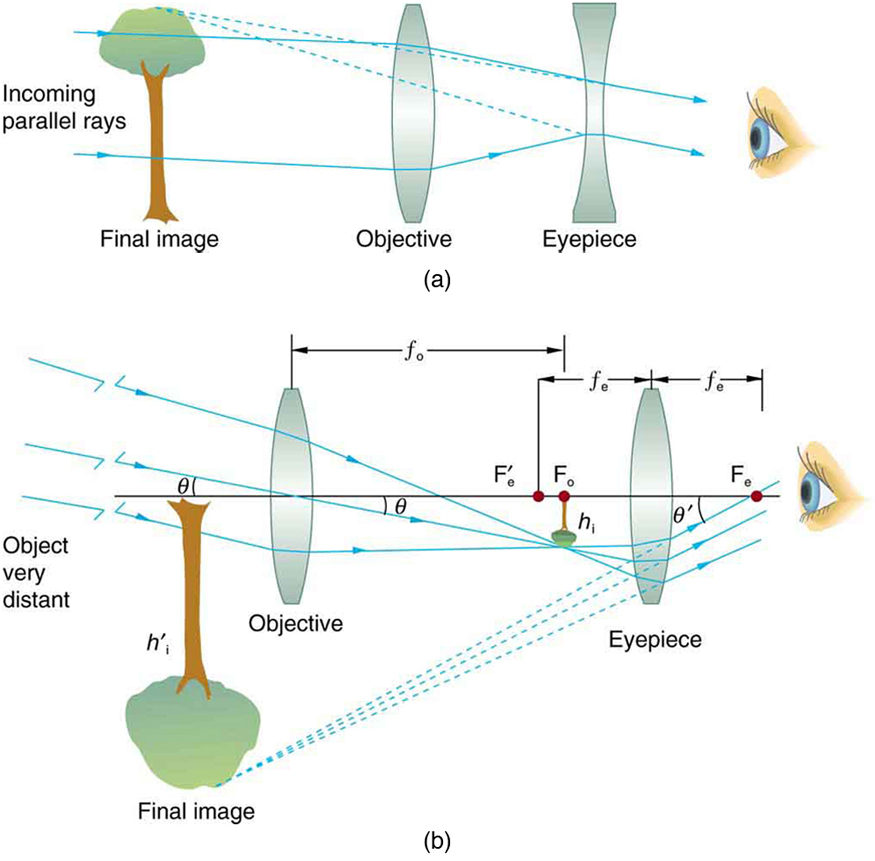
Effigy 1. (a) Galileo made telescopes with a convex objective and a concave eyepiece. These produce an upright image and are used in spyglasses. (b) Most simple telescopes have two convex lenses. The objective forms a case one epitome that is the object for the eyepiece. The eyepiece forms a example 2 final epitome that is magnified.
The most common two-lens telescope, like the unproblematic microscope, uses 2 convex lenses and is shown in Figure 1b. The object is so far abroad from the telescope that information technology is substantially at infinity compared with the focal lengths of the lenses (d o ≈ ∞). The first image is thus produced at d i =f o, as shown in the effigy. To show this, notation that
[latex]\displaystyle\frac{i}{d_{\text{i}}}=\frac{i}{f_{\text{o}}}-\frac{i}{d_{\text{o}}}=\frac{1}{f_{\text{o}}}-\frac{i}{\infty}\\[/latex]
Considering [latex]\frac{i}{\infty}=0\\[/latex], this simplifies to [latex]\frac{ane}{d_{\text{i}}}=\frac{1}{f_{\text{o}}}\\[/latex], which implies that d i =f o, as claimed. It is true that for any distant object and any lens or mirror, the paradigm is at the focal length.
The first image formed by a telescope objective as seen in Figure 1b will non be big compared with what y'all might see past looking at the object directly. For example, the spot formed by sunlight focused on a piece of newspaper by a magnifying drinking glass is the image of the Dominicus, and it is small. The telescope eyepiece (similar the microscope eyepiece) magnifies this get-go paradigm. The altitude between the eyepiece and the objective lens is made slightly less than the sum of their focal lengths so that the first paradigm is closer to the eyepiece than its focal length. That is, d o′ is less than f e, and then the eyepiece forms a instance ii image that is big and to the left for easy viewing. If the angle subtended by an object every bit viewed by the unaided heart is θ, and the angle subtended by the telescope prototype is θ′, and then the angular magnification M is defined to be their ratio. That is, [latex]M=\frac{\theta^{\prime}}{\theta}\\[/latex]. Information technology can be shown that the angular magnification of a telescope is related to the focal lengths of the objective and eyepiece; and is given by
[latex]\displaystyle{M}=\frac{\theta^{\prime}}{\theta}=-\frac{f_{\text{o}}}{f_{\text{due east}}}\\[/latex]
The minus sign indicates the epitome is inverted. To obtain the greatest angular magnification, it is all-time to have a long focal length objective and a short focal length eyepiece. The greater the angular magnification Grand, the larger an object will appear when viewed through a telescope, making more details visible. Limits to observable details are imposed by many factors, including lens quality and atmospheric disturbance.
The paradigm in most telescopes is inverted, which is unimportant for observing the stars merely a existent problem for other applications, such as telescopes on ships or scope gun sights. If an upright image is needed, Galileo'southward organisation in Effigy 1a can be used. Only a more mutual arrangement is to use a third convex lens as an eyepiece, increasing the distance between the first two and inverting the prototype once over again as seen in Figure 2.
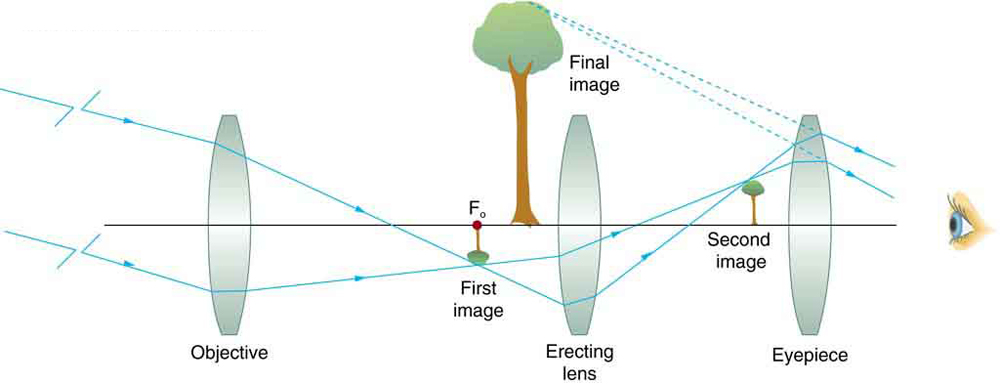
Figure 2. This arrangement of 3 lenses in a telescope produces an upright final epitome. The kickoff two lenses are far plenty autonomously that the 2d lens inverts the image of the start i more than time. The third lens acts every bit a magnifier and keeps the image upright and in a location that is easy to view.
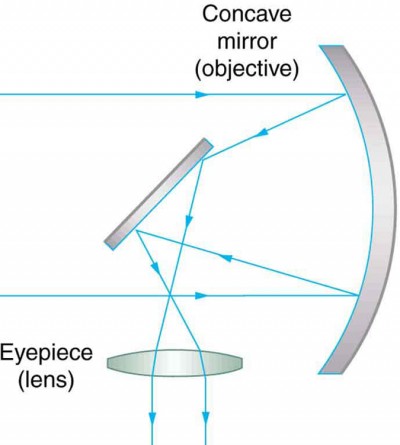
Figure 3. A 2-element telescope equanimous of a mirror equally the objective and a lens for the eyepiece is shown. This telescope forms an image in the same manner as the two-convex-lens telescope already discussed, but it does not suffer from chromatic aberrations. Such telescopes can gather more light, since larger mirrors than lenses can exist constructed.
A telescope can also exist made with a concave mirror as its first chemical element or objective, since a concave mirror acts similar a convex lens every bit seen in Figure 3. Apartment mirrors are oft employed in optical instruments to make them more compact or to send light to cameras and other sensing devices. At that place are many advantages to using mirrors rather than lenses for telescope objectives. Mirrors can be constructed much larger than lenses and tin can, thus, gather large amounts of light, as needed to view distant galaxies, for instance. Large and relatively flat mirrors take very long focal lengths, then that bang-up athwart magnification is possible.
Telescopes, similar microscopes, tin apply a range of frequencies from the electromagnetic spectrum. Effigy 4a shows the Commonwealth of australia Telescope Compact Assortment, which uses half-dozen 22-k antennas for mapping the southern skies using radio waves. Figure 4b shows the focusing of ten rays on the Chandra X-ray Observatory—a satellite orbiting earth since 1999 and looking at high temperature events equally exploding stars, quasars, and black holes. Ten rays, with much more than free energy and shorter wavelengths than RF and light, are mainly captivated and not reflected when incident perpendicular to the medium. But they tin be reflected when incident at minor glancing angles, much similar a stone will skip on a lake if thrown at a minor bending. The mirrors for the Chandra consist of a long barrelled pathway and 4 pairs of mirrors to focus the rays at a signal 10 meters away from the entrance. The mirrors are extremely shine and consist of a drinking glass ceramic base with a sparse coating of metallic (iridium). Four pairs of precision manufactured mirrors are exquisitely shaped and aligned so that x rays ricochet off the mirrors like bullets off a wall, focusing on a spot.
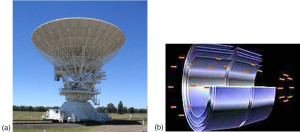
Effigy four. (a) The Australia Telescope Compact Array at Narrabri (500 km NW of Sydney). (credit: Ian Bailey) (b) The focusing of 10 rays on the Chandra Observatory, a satellite orbiting earth. Ten rays ricochet off four pairs of mirrors forming a barrelled pathway leading to the focus point. (credit: NASA)
A electric current exciting development is a collaborative endeavor involving 17 countries to construct a Foursquare Kilometre Array (SKA) of telescopes capable of covering from 80 MHz to two GHz. The initial stage of the project is the construction of the Australian Square Kilometre Array Pathfinder in Western Commonwealth of australia (see Figure 5). The project will employ cut-edge technologies such as adaptive optics in which the lens or mirror is constructed from lots of carefully aligned tiny lenses and mirrors that tin be manipulated using computers. A range of apace changing distortions can be minimized by deforming or tilting the tiny lenses and mirrors. The use of adaptive optics in vision correction is a current area of inquiry.

Figure v. An artist's impression of the Australian Square Kilometre Assortment Pathfinder in Western Australia is displayed. (credit: SPDO, XILOSTUDIOS)
Section Summary
- Elementary telescopes can exist made with ii lenses. They are used for viewing objects at big distances and utilize the entire range of the electromagnetic spectrum.
- The angular magnification 1000 for a telescope is given past [latex]M=\frac{\theta^{\prime}}{\theta }=-\frac{{f}_{\text{o}}}{{f}_{\text{eastward}}}\\[/latex], where θ is the angle subtended by an object viewed by the unaided center, θ′ is the angle subtended by a magnified image, and f o and f east are the focal lengths of the objective and the eyepiece.
Conceptual Questions
- If you desire your microscope or telescope to project a real image onto a screen, how would you alter the placement of the eyepiece relative to the objective?
Problems & Exercises
Unless otherwise stated, the lens-to-retina altitude is 2.00 cm.
- What is the athwart magnification of a telescope that has a 100 cm focal length objective and a 2.fifty cm focal length eyepiece?
- Notice the distance between the objective and eyepiece lenses in the telescope in the to a higher place problem needed to produce a final image very far from the observer, where vision is almost relaxed. Note that a telescope is usually used to view very distant objects.
- A large reflecting telescope has an objective mirror with a 10.0 one thousand radius of curvature. What angular magnification does it produce when a iii.00 thousand focal length eyepiece is used?
- A small telescope has a concave mirror with a ii.00 m radius of curvature for its objective. Its eyepiece is a 4.00 cm focal length lens. (a) What is the telescope's angular magnification? (b) What bending is subtended by a 25,000 km diameter sunspot? (c) What is the bending of its scope image?
- A vii.5× binocular produces an athwart magnification of −7.50, interim like a telescope. (Mirrors are used to make the epitome upright.) If the binoculars have objective lenses with a 75.0 cm focal length, what is the focal length of the eyepiece lenses?
- Construct Your Own Problem. Consider a telescope of the type used by Galileo, having a convex objective and a concave eyepiece as illustrated in Effigy 1a. Construct a problem in which yous calculate the location and size of the image produced. Amid the things to exist considered are the focal lengths of the lenses and their relative placements too as the size and location of the object. Verify that the athwart magnification is greater than one. That is, the angle subtended at the eye by the image is greater than the angle subtended by the object.
Glossary
adaptive optics: optical technology in which computers adjust the lenses and mirrors in a device to right for image distortions
angular magnification: a ratio related to the focal lengths of the objective and eyepiece and given as [latex]Thou=-\frac{{f}_{\text{o}}}{{f}_{\text{e}}}\\[/latex]
Selected Solutions to Problems & Exercises
i. −xl.0
iii. −i.67
v. +10.0 cm

How To Draw Ray Diagram Of Galilean Telescope,
Source: https://courses.lumenlearning.com/physics/chapter/26-5-telescopes/
Posted by: diaztheridly.blogspot.com
0 Response to "How To Draw Ray Diagram Of Galilean Telescope"
Post a Comment